
Female genital mutilation

In the Netherlands, we have been faced with female genital mutilation (FGM) since the beginning of the nineties. This is due to the immigration of women from countries where FGM is common practice.

The fight against FGM is complex and requires a comprehensive and targeted approach. Since 1993, Pharos has been a knowledge and advice centre for the fight against FGM. We have been designated by the Dutch government as a national expertise centre on FGM.

What is Female genital mutilation (FGM)?

Female genital mutilation is a procedure on the external female genitalia without any medical necessity.

The World Health Organization (WHO) distinguishes four types of female genital mutilation. They are explained in these drawings on Wikipedia.

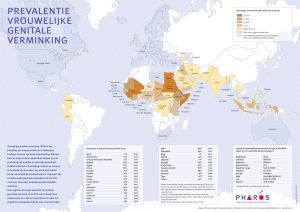
Wereldkaart met prevalentie

FGM or female circumcision?

The term preferred by the WHO is female genital mutilation. The Dutch government rejects the term girl circumcision, because it, like the WHO, considers the practice to be a form of mutilation. Therefore, in all official documents for policy makers, policy implementers and care providers in the Netherlands the term ‘vrouwelijke genitale verminking’ (female genital mutilation) is used.

However, in direct contact with people from the communities at risk of FGM, professionals are advised to talk about female circumcision (meisjesbesnijdenis). In such conversations it is of great importance to build a relationship of trust. Thus, it is useful to use a non-judgmental term.

Research on FGM in the Netherlands

  • In 2026 Pharos presented the results of a new prevalence and risk study on FGM in the Netherlands. On January 1st 2023, there were approximately 144.00 women and girls living in the Netherlands originating from so-called risk countries. The study estimated that 43.500 of these women and girls had undergone FGM. Approximately 2.600 girls are estimated to be at real risk of FGM in the next 20 years if preventive measures do not reach them. The original research report is available in Dutch: Vrouwelijke Genitale Verminking – Omvang en risico in Nederland.
  • In 2005, the Board of Health (RVZ) investigated whether girls were being circumcised in the Netherlands. The study focused on girls who had migrated from risk countries to the Netherlands. This small study showed that FGM does occur in the Netherlands. The RVZ estimated at the time that at least 50 girls were being circumcised in the Netherlands each year.
  • In 2008, TNO did a retrospective study on the prevalence of FGM in all midwifery practices. This study showed that 4 out of 10 pregnant women from risk countries who give birth in the Netherlands were circumcised.
  • In 2013, Pharos conducted the first prevalence and incidence study on FGM in the Netherlands. According to the study an estimated 29,000 circumcised women lived in the Netherlands and approximately 40 to 50 girls were at risk annually.
  • In 2017, Pharos conducted a study on circumcised women’s experiences with general practitioners in the Netherlands. An English article was published of this study:  Female genital mutilation and women’s healthcare experiences with general practitioners in the Netherlands: A qualitative study
  • In 2019, Pharos conducted a comparison study on FGM estimates based on direct estimation and the extrapolation-model. An English article was published of this study:  Estimates of female genital mutilation/cutting in the Netherlands: a comparison between a nationwide survey in midwifery practices and extrapolation-model

Background & reasons for FGM

The circumcision or cutting of the external genitalia of girls is a cultural tradition that is connected to notions of cleanliness, beauty, femininity and sexual morality. The reasons parents are giving for circumcising their daughters, vary from family to family and from community to community. Typically, this is done to protect the social status of the family and to increase a girl’s chances of finding a marriage partner. This way, parents try to secure the future of their daughters. Marriageability, therefore, is an important factor.

Parents’ decision to circumcise a daughter is also influenced by the prevailing social norms: people feel compelled to have their daughters circumcised, because others have also done so. Many girls and women take FGM for granted: it is part of life, after all everyone is circumcised. Local power structures – from community and religious leaders to women who perform circumcisions – are playing a major role in continuing or eliminating this tradition.

The exact origin of FGM is not clear. In Egypt, mummies have been found of circumcised women dating from 2000 BC. The tradition is often associated with Islam. However, FGM is not mentioned in the Quran as a religious requirement, nor in the hadith.

There are countries where Islam is the main religion but where FGM does not occur. Furthermore, FGM is also practiced by (Coptic) Christians and animist communities. In some regions, this pre-Christian and pre-Islamic practice has become intertwined with religion.

Health problems

Female genital mutilation can cause physical, psychological and sexual problems. There is a high probability these problems will occur, both shortly after surgery and in the long term. Mostproblems develop after an infibulation. Women and girls do not necessary relate the health problems they experience to FGM.

Physical effects during and immediately after the procedure

  • Extreme pain (in case the procedure takes place without anaesthesia)
  • Complaints of the urinary tract (painful urination, accumulation of urine in the bladder)
  • Excessive bleeding
  • Risk of infection (locally, possibly with ulcer formation, but also hepatitis, HIV, and
    tetanus)
  • Shock
  • Death

Consequences in the longer term

Physical

  • Menstrual problems
  • Painful and/or difficult urination
  • Urinary tract infections
  • Chronic pelvic pain
  •  Chronic infections
  • Having difficulty getting pregnant
  • Scarring
  • Increased risk of HIV infection
  • Difficult internal examination (smear test)
  • Difficult childbirth
  • Medical intervention to enable sexual intercourse and childbirth

Psychosocial and sexual

  • Anxiety and depression
  • Post-traumatic stress disorder (PTSD)
  • Negative impact on sexuality
  • Negative impact on physical sexual response in women

The fight against FGM is complex and requires a comprehensive and targeted approach. Since 1993, Pharos has been a knowledge and advice centre for the fight against FGM. We have been designated by the Dutch government as a national expertise centre on FGM.

The Dutch chain approach

Together, governmental and non-governmental organizations in the Netherlands have achieved many accomplishments. The Dutch Chain Approach is well known in many countries. There are very few other countries in Europe where the chain of prevention, care, law enforcement and education – especially through the engagement of the indispensable key persons – has been established this well. It is the combination of education, prevention and punishability/law enforcement that works.

Policy

The Dutch government has been involved in the fight against FGM since the early nineties. This involvement is connected to the arrival of refugees from countries in which FGM is practiced. In 1993, the Netherlands adopted the position that all forms of FGM are prohibited. This prohibition is in line with the WHO position statement that not a single form of FGM should be tolerated.

The Dutch policy is aimed on the one hand at preventing that girls and women living in the Netherlands are being circumcised, and on the other hand, at providing good-quality medical and psychosocial care to women and girls who have been circumcised. The national policy thus focuses not only on legal measures, but also on prevention and health care.

Over the years, various policy developments regarding FGM have occurred in the Netherlands. The national policy is closely linked to developments elsewhere in the world and internationally.

Below you will find a chronological overview of policy developments regarding FGM in the Netherlands. This development is closely linked to developments elsewhere in the world and at the international level.

The Netherlands came into contact with FGM for the first time in the early nineties, when women from countries in which FGM is prevalent first arrived in the country. How has the policy developed since then?

FGM policy developement since 1992
1992 Bartels and Haaijer wrote a research report on female circumcision among Somali women in the Netherlands. This led to the very first public attention to FGM in the Netherlands.
1993 The government issued its official position that all forms of FGM are prohibited. The reason is that FGM contradicts the prevailing views in the Netherlands on the equality of women and their position in society. All forms of FGM are regarded as serious, irreversible forms of bodily injury, with high risks of physical and psychological symptoms.
1993 – 2005 In this period various separate projects took place, initiated by several NGOs. There was no national framework and policy. Initiatives in this period included:
  • National information and consultation point on FGM (Pharos, 1995 – 1997)
  • Awareness campaigns for the Somali community, training of leaders, network of female experts coordinated by Vluchtelingen-Organisaties Nederland (VON) since 1993
  • National campaigns aimed at the Somali community (FSAN, 1996 – 1997)
  • Radio report on 'holiday circumcisions' in Somalia (1999)
  • Creation of the Platform Approach on female genital mutilation (2000)
  • Project ‘From Policy to Practice’ (Pharos/FSAN, 2000 – 2002)
  • Project ‘Network of key persons and contacts on female circumcision’ (FSAN/Pharos, 2003 – 2004)
  • Door-to-door campaign for the Sudanese community in the Netherlands (2005)
2005 The Council for Public Health and Health Care (RVZ) published its advice on how FGM could be combated effectively in the Netherlands.
In the position paper issued by the Cabinet on August 26, 2005, the government had formulated a reaction to the RVZ advice. The government opted for a two-track policy: promoting prevention and upholding the statutory prohibition of FGM. In addition, the focus would be on a chain approach, in which preventative actions would be taken from different perspectives and at different levels. With this policy, the Cabinet adopted many of the recommendations from the RVZ advice report.
The government's position has been in accordance with the vision of WHO and UNICEF that change in a community can happen if measures are taken to enable this change, such as support, facilitation and encouragement. Legislation is a support tool that can be used as a ‘big stick’. But it is not the most important instrument.
2006 – 2009 Commissioned by the Ministry of Health, the pilot ‘Preventing FGM’ was performed in six major cities where relatively many people from the communities at risk were living. It was an intensive collaboration between Municipal Health Services (GGD) of the six pilot municipalities, Pharos and FSAN. The purpose of the pilot was to develop coherent prevention activities through a chain approach. The purpose of the prevention activities was twofold:
  • establish behaviour change through awareness among high-risk groups
  • increase the sense of urgency regarding FGM among all partners in the chain
In 2007, this pilot received additional support through the policy brief ‘Beschermd en weerbaar’ (Protected and resilient). In this brief, attention was drawn to forms of violence such as FGM in dependent relationships.
The evaluation of the pilot showed that the integrated chain approach on prevention seemed to bear some fruits. Improvements were recommended in the areas of:
  • embedding and securing of knowledge and action
  • medical and psychological care for circumcised women
  • role of primary education in prevention and detection
  • signaling a (forthcoming) circumcision
An evaluation by the Advice and Reporting Centres on Child Abuse (AMK) showed that in the period from July 2007 to February 2008, 44 requests for advice and reports on FGM had been sent to the AMK and the Council for Child Protection.
2010 – 2011 In the nationwide rollout of the prevention project, points for improvement from both evaluation reports have been included. This project took place in 2010 and 2011 with the following partners:
  • GGD Netherlands: national coordination, quality assurance and rollout of the preventive approach regarding FGM within the Youth Health Care system (including health education in refugee centres).
  • FSAN/VON: the national rollout of FGM prevention activities by self-help organizations and key persons (including group education in asylum centres).
Also, there has been more focus on activities in the field of medical and psychosocial care.
2013 EIGE published a new fact sheet about the Dutch policy in the field of FGM.

Current situation and trends of female genital mutilation in the Netherlands (EIGE, 2013)

2014 – 2015 After a pilot in 2011 in The Hague, consultation hours were held in the period 2012 to 2015 for circumcised women in six locations in the Netherlands (The Hague, Tilburg/Den Bosch, Eindhoven, Groningen, and Rotterdam). In Nijmegen, the consultation was held by a family doctor. In 2015, the Apeldoorn region decided to set up a consultation too. Since the conclusion of the pilot, there are consultation hours at various locations. The report (in Dutch) is available by contacting Erick Vloeberghs (e.vloeberghs@pharos.nl).
Through information sessions and home visits women from high-risk countries were briefed during the pilot by key persons about the existence of these consultations and were accompanied to the services when they had complaints. At each location, staff informed healthcare professionals about the services. During the consultation, a trained nurse or a doctor tries to define the health problem. If necessary, women are referred to other health services for further assistance.
New risk countries. Since 2014, it has become increasingly clear that female circumcision is not only taking place in Africa but also in the Middle East and in Asia. Given the large number of Indonesian women in the Netherlands, Pharos conducted an exploratory study among that group in the period April 2014 – January 2015.
The validity of the ‘Model Protocol on medical care for women and girls with female genital mutilation (FGM)’ has expired. Since the end of 2015, this protocol will be converted into a multidisciplinary guideline on care for women with FGM. Its development takes place by a core team consisting of members of SRH professional organizations, FSAN (for the patient perspective) and Pharos, in close consultation with the advisory board.

Legislation

Punishability

  • In the Netherlands, FGM is punishable as a form of child abuse (art. 300-304, 307, 308 Penal Code). There is a maximum sentence of 12 years or a maximum fine of 76,000 euros. In case parents perform the circumcision themselves on their own daughter or on a child over whom they exercise parental authority or whom they care for or raise, the imprisonment term may be increased by one third (art. 304 sub 1 Penal Code). They are also punishable if they allow and/or support the procedure to be performed, order it, pay for it, provide the means for it and/or assist the circumciser during the circumcision. These acts are considered soliciting, abetting or co-perpetration under Dutch criminal law (art. 47 and 48 Penal Code).
  • In March 2013, the Penal Code and the Code of Criminal Procedure were amended in order to widen the possibilities for criminal prosecution of cases of forced marriage, polygamy and FGM. With regard to FGM the jurisdiction has been extended in the sense that incidences of FGM performed abroad are also punishable in the Netherlands in case the victim is a Dutch citizen or has a permanent place of residence in the Netherlands. This also applies when the offender is a foreign national and/or is not a resident of the Netherlands.
  • Since February 1, 2006, it has been possible to prosecute someone for carrying out an FGM abroad if the suspect has the Dutch nationality or is permanently residing in the Netherlands.
  • Since July 1, 2009, the limitation period has been extended. Any woman can now file a report of her circumcision at a younger age when she is between the age of 18 and 38.

Residency

Since 2001 it has been possible for minors to appeal for a residence permit called ‘Asiel voor bepaalde tijd’ (limited-term asylum) when there is a proven threat of FGM. See Article 3.2 and Article 3.3 of the Aliens Act Implementation Guidelines (2000) for the latest information provided by the Immigration and Naturalization Service (IND).

Disciplinary action

Health-care providers who participate in  FGM can be tried under medical disciplinary law. In the bulletin ‘Vrouwelijke genitale verminking’ (2010), the Inspectorate for Health Care brought together the relevant legislation and field standards regarding FGM. This document states that care providers should not be engaged in the performance of FGM and reinfibulation, neither with regards to minors nor adults.

Reporting Code

Since July 1, 2013, organizations and self-employed professionals are required to have a reporting code. This is stipulated in the law ‘Mandatory reporting of domestic violence and child abuse’. The reporting code helps professionals such as doctors, teachers and employees of youth institutions to respond appropriately to signs of violence. The prevention of FGM is included in the law. The aim of the law is that professionals should identify mistreatment in the home environment at an early stage and report this when necessary. When confronted with a suspicion of an impending or performed FGM, professionals should act according to the roadmap pertaining to their own reporting code.

Naar boven